
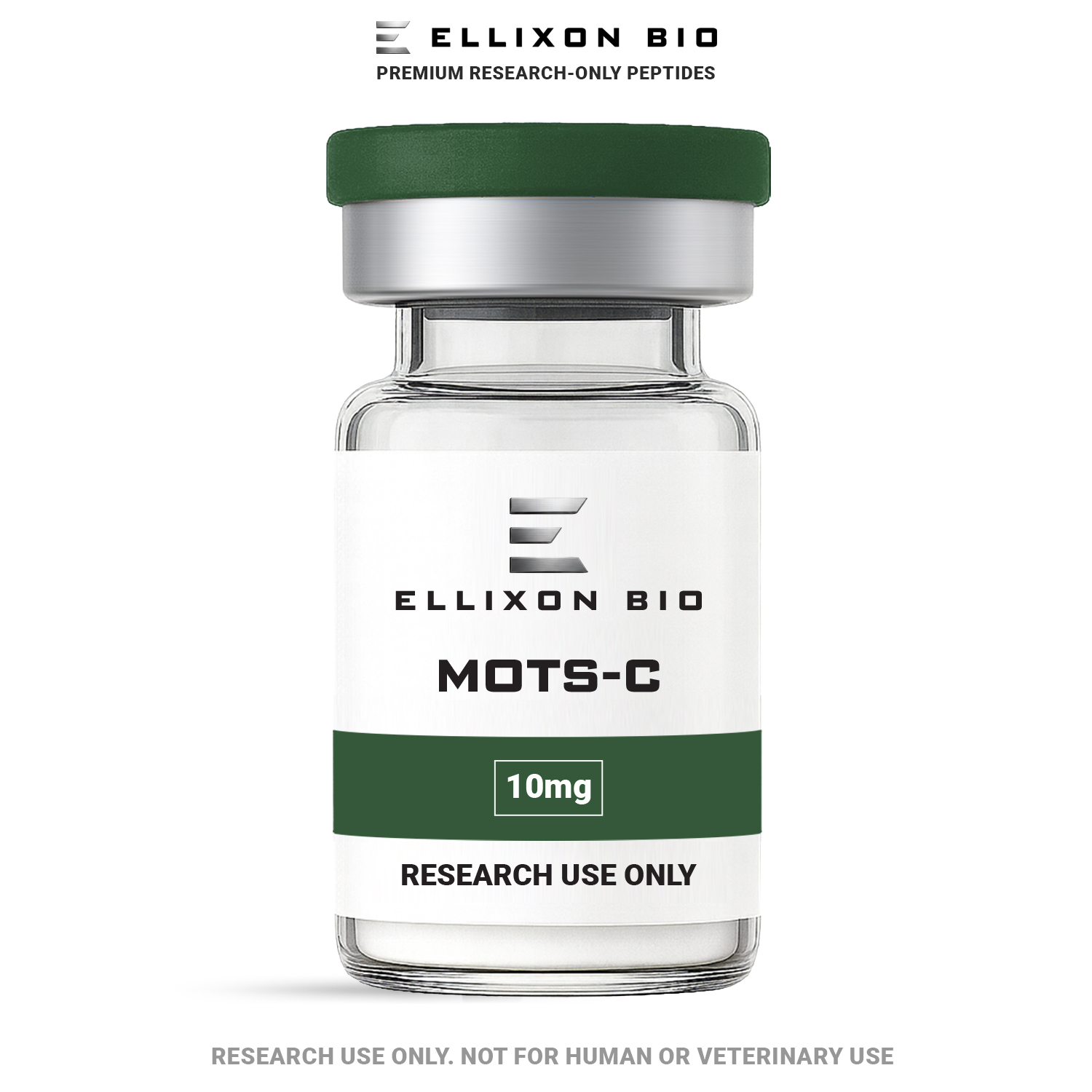
MOTS-c is a 16-amino-acid mitochondrial-derived peptide used in RUO bioenergetic models to probe metabolic regulation and stress adaptation. Studies evaluate folate–purine–AMPK pathway interactions, glucose handling, and adaptive gene programs under metabolic stress. Not intended for diagnostic or therapeutic use.
- AMPK-linked energy regulation assays
- Metabolic stress response and gene programs
- Insulin sensitivity & mitochondrial signaling models
MOTS-C | Molecular Identity & Composition
| Name | MOTS-c |
| Sequence | Met-Arg-Trp-Gln-Glu-Met-Gly-Tyr-Ile-Phe-Tyr-Pro-Arg-Lys-Leu-Arg (MRWQEMGYIFYPRKLR) |
| Molecular Formula | C101H152N28O22S2 |
| Molecular Weight | 2174.6 g/mol |
| CAS Number | 1627580-64-6 |
| Appearance | White to off-white lyophilized powder |
| Solubility | Soluble in sterile water or bacteriostatic water |
| Purity | ≥99% (HPLC) |
| Storage Guidelines | • Lyophilized: ≤0°F (–18°C), dry, protected from light • Reconstituted: 36–46°F (2–8°C); avoid repeat freeze–thaw • Long-Term: Keep dry and frozen until use |
Ellixon Bio Quality Advantage
- Purity & Identity: ≥99% | HPLC & MS validated
- Endotoxin & Sterility: <0.05 EU/mg | Third-party verified
- Stability & Process: Controlled nucleation lyophilization | Stability-focused procedures
- Formulation & QA: PhD-Formulated | GMP / ISO-Aligned manufacturing
- Packaging: Luxe Fridge-Ready Box
Category Overview | Signal Transduction Pathways
Signal transduction peptides are used in RUO studies to explore how cells send and receive messages. These signals help control how cells grow, repair themselves, and respond to stress. Researchers use these peptides in lab models to better understand how communication inside cells works—and what happens when it doesn’t.
Exciting Areas of Study
- Modulation of ATP output in energy-restricted cellular environments.
- Pre-clinical insights into mitochondrial performance.
- Stress-induced metabolic pathway behavior in controlled assays.
- Early-stage models of energy dysregulation across tissue types.
- Insulin sensitivity & glucose regulation in cell-based assays.
MOTS-C | Research Modeling & Applications
- Probe AMPK activation and downstream bioenergetics
- Model insulin sensitivity and substrate utilization
- Assess stress-adaptive transcriptional programs
Research Use Disclaimer
This product is supplied for laboratory research use only (RUO) and is intended solely for qualified professionals in a controlled research setting. It is not a drug, food, dietary supplement, cosmetic, or medical device, and is not intended for human or veterinary use or for any diagnostic, therapeutic, or clinical application. It is not for household use.
No statement on this page has been evaluated by the U.S. Food and Drug Administration. Nothing herein is intended to diagnose, treat, cure, or prevent any disease, nor to suggest any dosage, route, or method of administration. Ellixon Bio makes no representation or warranty, express or implied, regarding fitness for any purpose other than research and provides no medical or professional advice. The purchaser and end user assume full responsibility for safe handling, storage, and use in accordance with all applicable laws, regulations, and institutional safety protocols, and accept all associated risk and liability.
See our Terms & Conditions and our Research Compliance Disclaimers for complete terms.